
Curious about pup play but unsure where to begin? You are definitely not alone.
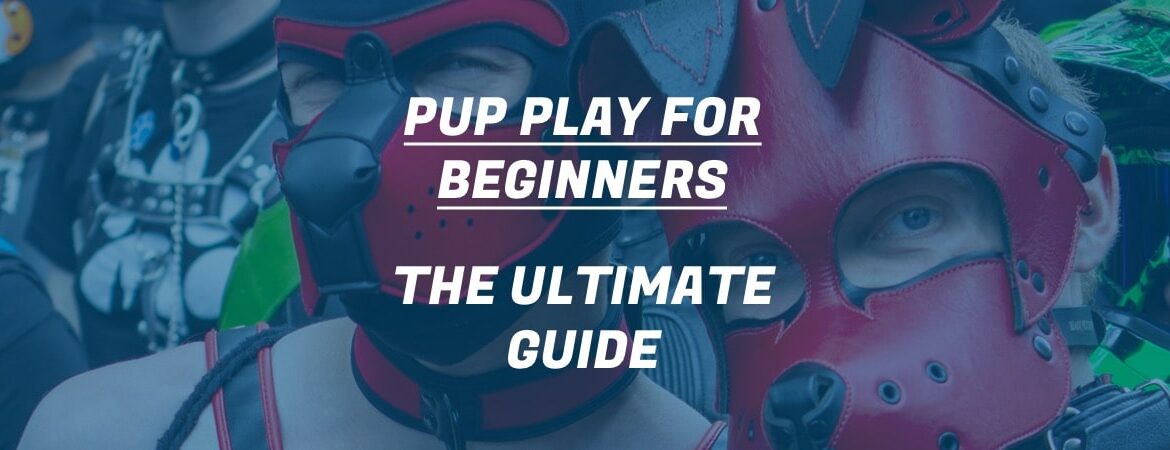
You might have encountered a pup wearing a hood at Pride. Perhaps your partner called you a “good pup” and something unexpectedly clicked. Maybe you are attracted to the gear, the playful power exchange, the sexual side, the community, or simply the freedom of stepping away from everyday responsibilities for a while.
All of those are valid reasons to be curious.
Pup play is a form of adult roleplay in which someone explores a puppy-like persona or headspace, while another person may take on the caring or guiding role of a handler. It can be playful, intimate, sexual, social, comforting, creative or a mixture of several things. There is no single correct way to be a pup.
When my partner and I first discovered pup play through a Halloween event in 2012, we did not start with everything figured out. We learned by exploring, talking, meeting other pups and noticing which parts felt right to us. Your pup experience can develop gradually too.
This beginner’s guide will help you:
- Understand what human pup play is
- Explore pup, handler and switch roles
- Try pup play alone or with a partner
- Learn beginner-friendly pup play commands and scene ideas
- Discover your pupsona without forcing it
- Choose gear according to what you want to experience
- Find community at your own pace
- Practise clearer communication, consent and safety
You do not need a name, a pup hood, a handler or a perfectly developed pupsona before you begin. Curiosity and open-mindedness is enough.
What Brings You To Pup Play?
Different people are looking for different things when they search for pup play. Before trying to fit yourself into somebody else’s version of it, consider what is drawing you in.
You may be interested in:
- Play and headspace: letting go, moving instinctively and enjoying a break from your everyday identity.
- Kink and intimacy: exploring praise, control, service, training, submission or another consensual dynamic.
- Pupsona and creativity: developing a name, personality, colors, traits and a style that feel like you.
- Gear and transformation: using a hood, collar, tail or outfit to express yourself or help shift your mindset.
- Connection and community: meeting other pups and handlers, attending events or sharing your pupsona.
- A partner dynamic: creating a playful, caring or structured experience with someone you trust.
You may want several of these things, or your interests may change over time. You do not have to choose a permanent category. During our many years of experience we’ve seen beginner pups develop and evolve in all directions of pup play, and every one of their pup journeys has been amazing to see.
Pup play can be sexual, but it does not have to be. Some people enjoy it mainly as kink. Others love the social, emotional, imaginative or creative aspects. Many of the pups we know enjoy a mix that changes depending on the setting.
If you are still wondering where pup play sits in relation to kink, you can read: Is Pup Play a Kink or Fetish?
How to Start Pup Play: Seven Beginner Steps
The easiest way to start pup play is not to buy everything or invent the perfect pupsona identity. Start small enough that you can notice what genuinely feels good.
Step 1: Learn the basic idea
Read a few beginner guides, observe how different adults practise pup play, check out a couple of pup instagram accounts, join the pup play subreddit and remember that what you see online is only one version of it.
A social pup at a mosh, a submissive pup in a private BDSM scene and someone quietly exploring pup headspace at home can all have completely different experiences. None of them has to define yours.
Step 2: Ask what feeling you want
Instead of immediately asking, “What kind of pup am I?”, try asking:
- Do I want to feel playful?
- Do I want affection, praise or attention?
- Do I enjoy rules and structure?
- Do I want to feel cheeky or mischievous?
- Am I drawn to submission or service?
- Do I want a sexual experience?
- Do I want to be cared for?
- Do I mainly want to create and show off a character or style?
You do not need perfect answers. These questions simply give you somewhere to begin.
Step 3: Try a few behaviours without gear
You can explore pup play without owning anything. n a private, comfortable space, you might try:
- Moving in a more pup-like way
- Playing with a favorite object or toy
- Making pup sounds if that feels natural
- Responding to praise
- Stretching, shaking out your body or imagining a wagging tail
- Resting on a mat or blanket you associate with pup time
- Looking into a mirror and noticing how your posture changes
- Letting yourself be silly without judging the result
Some pup behaviours will feel natural; others may feel awkward or uninteresting. That is useful information.
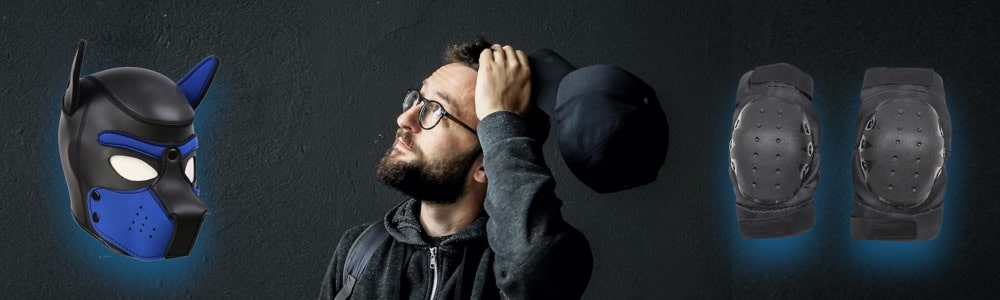
Protect your body while experimenting. Hard floors can quickly become uncomfortable for knees, wrists and ankles. Use padding, adjust your position regularly and stop when something hurts.
Step 4: Explore your role
You may feel drawn to being a pup, a handler, both, or neither label yet. Try to stay curious rather than treating the decision as a test you need to pass.
We will explore these roles more fully further down in the guide.
Step 5: Communicate before playing with someone else
Before partner play, talk outside the role about what both of you want.
Discuss activities, touch, words, intensity, limits, signals, sexual expectations and how either person can pause or stop. Do not rely on puppy behaviour or body language alone to communicate consent.
Step 6: Add only the pup gear that serves a purpose
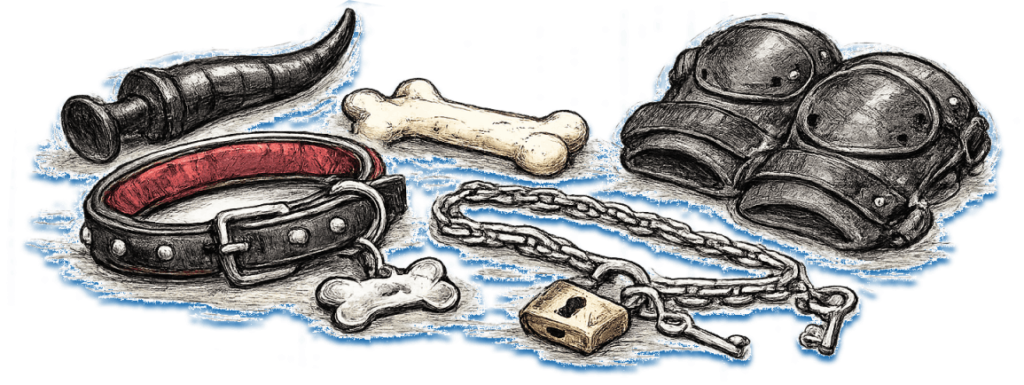
Gear is optional. If you want it, start by considering what you want the gear to help you feel or do. A collar creates a different experience from knee pads, and a hood serves a different purpose from a tail.
Step 7: Let your pup play evolve
Your first experiment does not have to reveal your complete pup identity.
Names change. Favorite colors change. People who begin as pups sometimes discover they enjoy handling more than being a pup. A private pup may later become social, or may remain happily private.
Pup, Handler or Both: Exploring Your Role
What does a pup do?
A pup is someone who enters a puppy-inspired role, persona or mindset. Depending on the person, this may include:
- Seeking affection, praise or attention
- Playing with toys
- Following agreed commands
- Communicating through sounds or movements
- Acting energetic, loyal, shy, curious or mischievous
- Exploring submission or service
- Socializing with other pups
- Expressing a pupsona through gear and style
Being a “good pup” does not mean obeying everybody. You decide who you play with, what you consent to and which commands (if any) you want to follow.
What does a handler do?
A handler helps create and guide the experience. This can include:
- Offering care, reassurance and attention
- Giving (agreed) commands
- Creating games or structured scenes
- Watching the environment and the pup’s wellbeing
- Providing praise or correction in ways negotiated beforehand
- And most importantly, making space for the pup to relax into their role
Handling is not simply “being in charge.” A thoughtful handler listens, respects limits and takes responsibility for the experience they are helping to create. You can learn more in: What Is a Handler in Pup Play? The Caring Role
Can you be both?
Absolutely. Some people are pups in one situation and handlers in another. Others switch roles with the same partner or enjoy helping newer pups socially.
You do not need to select one identity forever, and the roles do not depend on gender. You can be a puppy boy, puppy girl, nonbinary pup, handler or simply a person exploring pup play.
Beginner Human Pup Play Commands
Commands can provide structure, deepen headspace and turn a vague idea of “acting like a pup” into an activity you can actually try.
However, commands belong inside a consensual dynamic. Wearing pup gear does not give strangers permission to order someone around. Discuss which words you enjoy and how you want to respond before beginning.
Beginner commands might include:
- Sit: Settle into an agreed seated or kneeling position.
- Stay: Remain in a comfortable position for a short, agreed period.
- Come: Move toward the handler.
- Heel: Walk or move beside the handler.
- Fetch: Retrieve a safe toy or object.
- Drop: Release an object.
- Speak: Make a chosen pup sound.
- Quiet: Settle or stop vocalizing.
- Place: Move to an agreed mat, cushion or location.
- Look: Make eye contact, if eye contact feels comfortable.
- Up: Rise from the floor or change position.
- Free: End the command and return to unstructured play.
A handler can combine words with simple hand signals. This can be helpful in loud environments and also adds a training-like feeling.
Start with two or three commands rather than attempting a complete routine. Rewarding responses with praise, affection, a toy or another pre-agreed reward usually creates a more playful beginner experience than focusing on mistakes.
Useful phrases include:
- “Good pup.”
- “Would pup like to play?”
- “Show me your best sit.”
- “Good pup still wants to continue?”
- “Would you like a break?”
- “Free pup, go play.”
The last three are particularly important: pup language can maintain the atmosphere while still creating room for choice and check-ins.
Beginner Pup Play Scene Ideas
You do not need a complicated script. A simple scene with a beginning, a few activities and a clear ending is often better for a first experience.
A solo headspace session
Prepare a comfortable private space with a drink, music, a blanket and one or two objects that feel playful/pup like.
Spend ten or fifteen minutes stretching, moving, playing like a pup and responding to your own imagined cues. Afterwards, write down or think about what felt enjoyable, awkward, exciting or calming.
A gentle praise-and-play scene
One person takes the pup role while the other acts as handler. Begin with an agreed cue, perhaps putting on a collar or being invited onto a mat/couch.
The handler uses two or three easy commands, playful questions and plenty of agreed praise. Add a toy, a game of fetch or affectionate touch if wanted. Finish with the release command and a relaxed check-in.
A pup training scene
Choose a short sequence such as sit, stay, come and fetch. Agree on rewards, the desired tone and what happens when the pup does not follow a command.
Remember that “training” is still collaborative roleplay. It is not permission to humiliate, punish or touch someone in ways that were not discussed.
A cheeky pup game
The pup tries to steal a toy, hide an object or distract the handler. The handler attempts to redirect them using commands, trades and praise.
This can work well for people who enjoy mischievous energy more than formal obedience.
A more intimate or kinky scene
Pup play can be combined with dominance, submission, sexual activity, restraints or toys, but adding intensity also adds responsibility.
Agree on the exact activities, limits, safer-sex choices, signals, equipment and aftercare beforehand. Use equipment only when you understand how to use it safely, and do not introduce surprise activities in the middle of a scene.
How to Get into Pup Headspace
Pup headspace means different things to different people. Some describe it as playful and energetic. Others experience it as calm, instinctive, submissive, affectionate or freeing.
You cannot force pup headspace, but you can create tricks that make it easier to explore.
Create a transition ritual
Your ritual could be:
- Changing into different clothing / gear
- Putting on a collar, tag, hood or bandana
- Playing a particular song
- Moving to a specific mat or other play space
- Stretching and focusing on your breathing
- Hearing your pup name or an agreed praise phrase
- Looking at your Pupsona Card before playing
Using the same cue repeatedly can help separate pup time from the rest of your day.
Focus on sensation and movement
Pay attention to what your body is doing rather than trying to perform perfectly.
Notice the floor beneath you, the feeling of a toy in your hand or mouth, your breathing, your posture and how you react to attention. Stay aware of pain, overheating, dizziness or numbness; pup headspace is not a reason to ignore your body.
Experiment with language
Words can have a surprisingly strong effect. “Good boy,” “good girl,” “good pup,” a pup name or another phrase may help someone settle into the role.
Never assume which language a person wants. Ask first, especially when words carry gendered, sexual, submissive or emotional meaning.
Let yourself feel a little silly
Many beginners worry that they are doing it incorrectly. That self-consciousness is normal.
You do not need to bark convincingly, move gracefully or immediately lose yourself in the experience. The goal is not to impress an imaginary judge. It is to discover what helps you enjoy the moment.
How to Get into Handler Headspace
Handler headspace is not just about issuing commands. It is about becoming attentive to the pup and the experience you are building together.
A handler can prepare by asking:
- What kind of energy does this pup want today?
- Do they want gentle care, playful training, firm structure or something intimate?
- Which forms of praise do they enjoy?
- Which words or actions are off-limits?
- How will they communicate if speech becomes difficult?
- What physical support might they need?
- How will we end and reconnect after the scene?
During play, observe without assuming. A wag, sound or movement may be part of the role, but it is not automatically consent. Use the signals you agreed upon and check in when uncertain.
Good handling is collaborative. Your guidance should make it easier for the pup to explore, not pressure them to tolerate more.
Creating or Evolving Your Pupsona
A pupsona is the identity, personality or style you express through pup play. It may be a fully developed character, a playful extension of yourself or simply a name and color combination you enjoy.
You do not need a complete pupsona before participating. Some pups discover theirs gradually through play and community.
To begin, consider:
- What name would feel good to hear?
- Is your pup energetic, relaxed, loyal, cheeky, shy, affectionate or protective?
- Which forms of praise feel right?
- Do you enjoy following, leading, helping or causing playful trouble?
- Which colors, patterns or symbols catch your attention?
- Is your pupsona closely connected to you, or does it feel like a distinct character?
- What would you like other pups to know when they meet you?
If you already have a pupsona, these questions can still be useful. A pupsona is allowed to mature alongside you.
For a more complete process, read Create or Evolve Your Pupsona.
Create a Pupsona Card
Once you have a few ideas, you can bring them together in your own Pupsona Card
Your card can include your pup name, traits, role, colors and photo, but you do not need professional gear or even a photo to begin. Make the version that represents where you are now.
You can:
- Download your card to your device
- Share it wherever you feel comfortable
- Save it privately to your Puppy Play Expert account
- Return and update it as your pupsona evolves
- Choose separately whether you want it shown publicly for other pups to see
Keeping a card private is completely valid. If you want to introduce yourself, however, your card can give other pups and handlers an easy, creative way to meet you.
 OFFICIAL PUPSONA CARD
Give me your bone :#?
 OFFICIAL PUPSONA CARD
Want a lick :P?
 OFFICIAL PUPSONA CARD
The Naughty Pup

Always Down For Fun Times
OFFICIAL PUPSONA CARDThe Big Bone taker.

Anything you’d like others to know?
Ready to introduce your pupsona?
Create your card, save it privately or share it with the pack when you are ready.
Beginner Pup Play Gear: What Do You Actually Need?
You do not need any gear to be a real pup or handler. Gear becomes useful when it supports a feeling, activity or form of expression you actually want. Instead of asking, “What does every pup need?”, ask, “What would help me explore my version of pup play?”
For a complete overview, visit the Pup Play Gear Guide.
If you want transformation or stronger headspace
A pup hood or pup mask can change how you see yourself and make the transition into pup headspace feel more fluid.
Hoods vary in material, coverage, visibility, ventilation, fit and style. Consider comfort and function, not only appearance.
Helpful guides:
- What Is a Pup Hood and Why Do People Wear Them?
- Pup Hood vs Pup Mask: Which Should You Choose?
- Neoprene Pup Hood Guide
When wearing a hood, monitor heat, breathing, hearing and visibility. Take breaks, remain hydrated and do not use it in a situation where limited awareness would put you at risk.
If you want connection or symbolism
A collar, tag or lock necklace can symbolize a dynamic, display a pup name or simply complete a look.
Collars do not always indicate ownership or submission. Never assume what somebody’s collar means, and never grab or pull it without consent.
For more information about pup collars, read: Choosing the Perfect Pup Play Collar
If you want to move on the floor
Knee pads, elbow protection and pup mitts can make floor play more comfortable and protect the body from rough surfaces.
Padding does not make every position safe indefinitely. Change position, avoid forcing joints and stop if you experience pain, tingling or numbness.
If you want playful movement
A pup tail can add movement and personality. Belt-attached show tails provide a non-insertable option, while plug tails require additional preparation and body awareness.
For insertable tails, choose a body-safe product with a flared base, use suitable (often water-based) lubricant, clean it correctly and stop if you experience sharp pain, numbness or bleeding.
If you want games, kink or intimate play
Toys, gags and restraints can add structure and intensity, but they are not automatic beginner essentials.
Gags require an alternative communication system and close monitoring. Restraints need circulation checks and a reliable quick-release method. Do not leave a restrained or gagged pup unattended during play time.
If you want creative self-expression
A tag, bandana, harness, hood and coordinated outfit can turn colors and traits into a recognizable pup style.
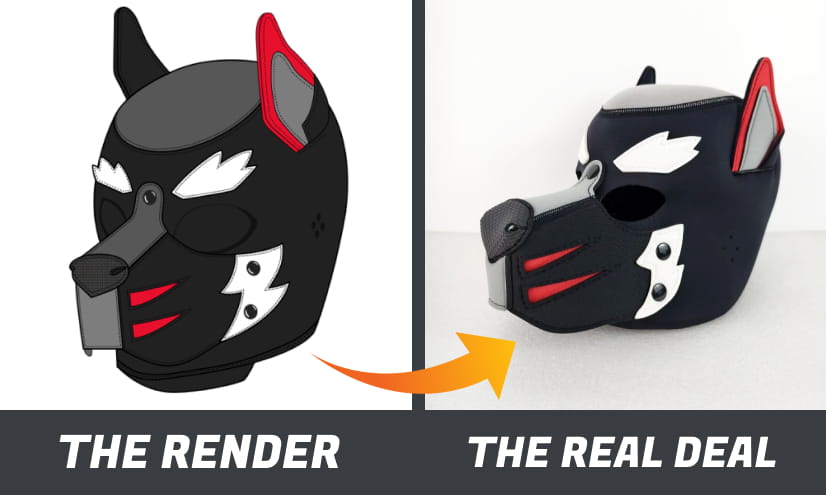
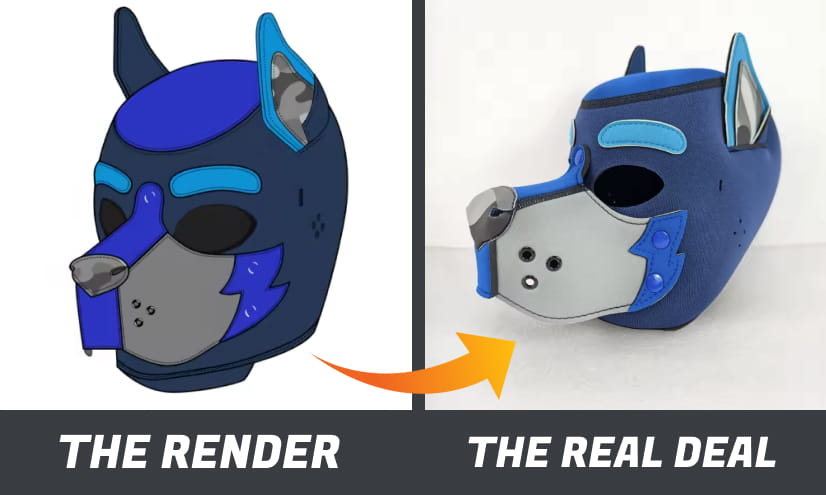
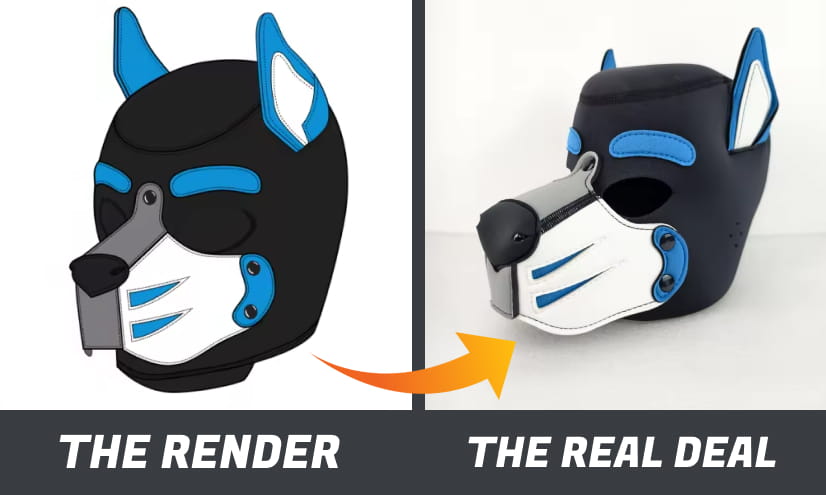
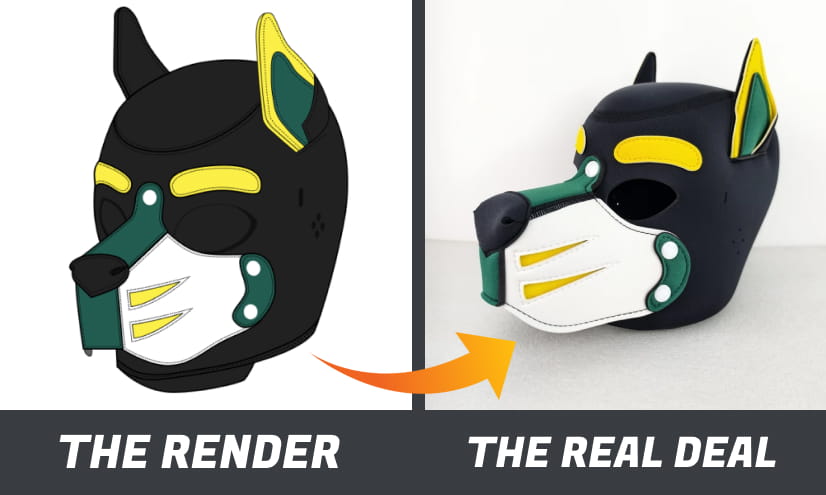
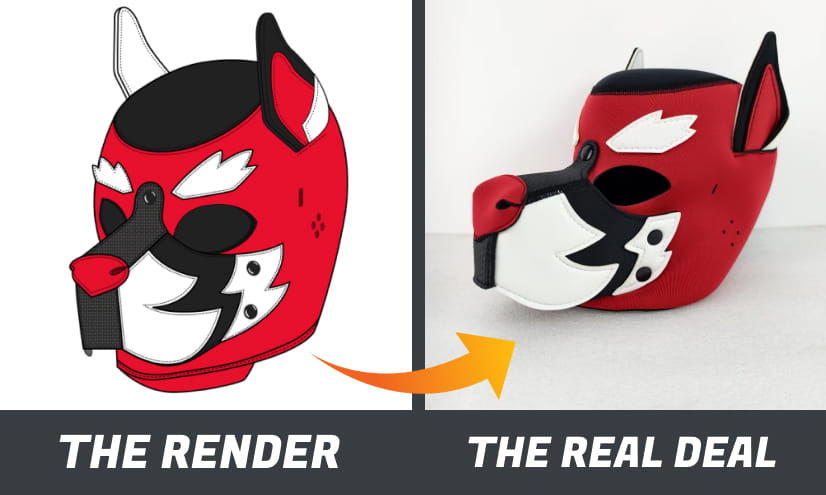
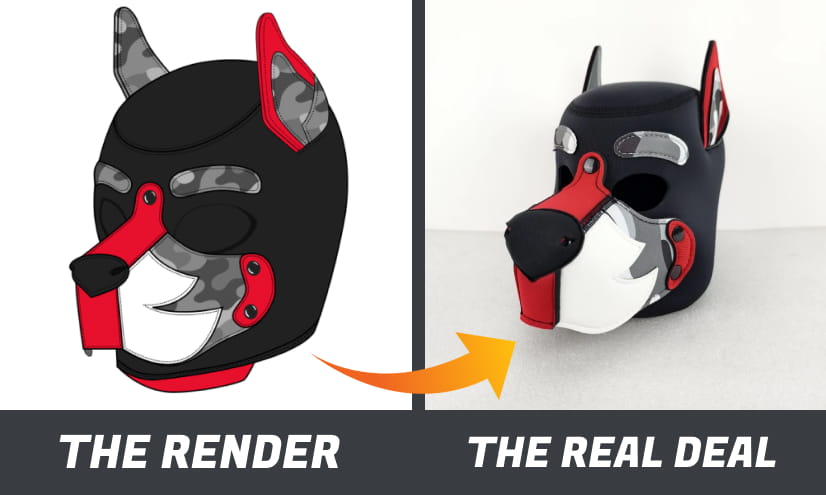
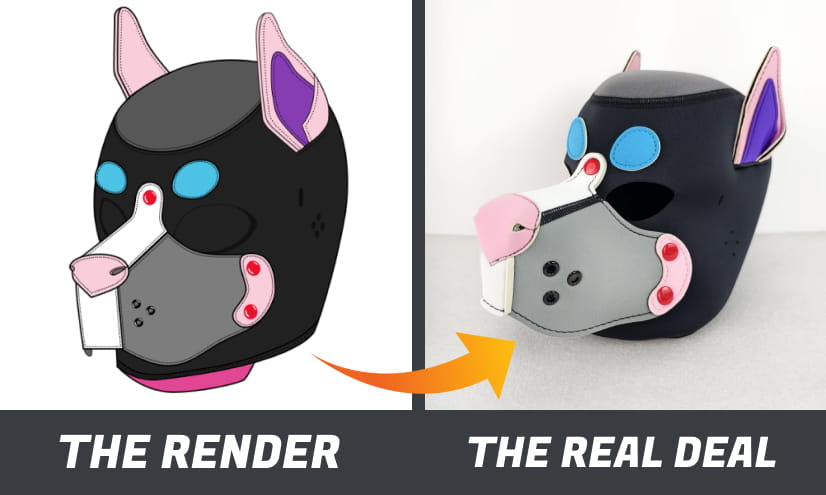
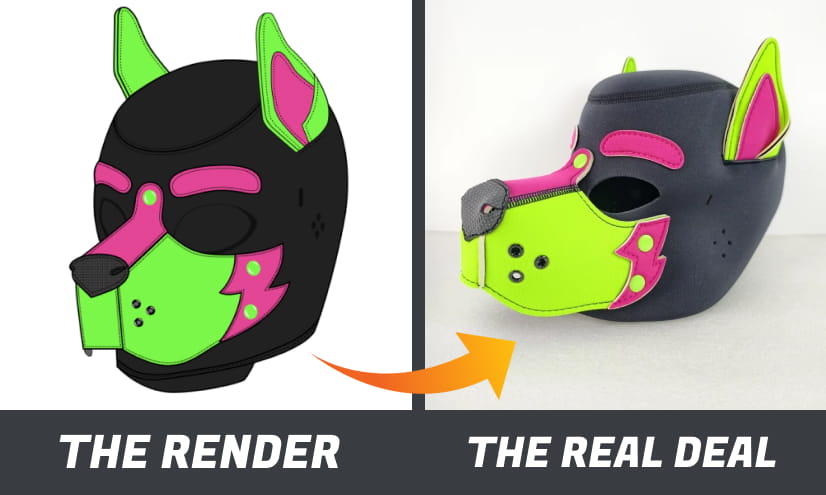
You can begin with something small. If designing a highly personal look is part of the fun, experiment with the Custom Pup Hood Designer and see how different colors and details change the character.
The best first purchase is not necessarily the most popular item. It is the one that supports what you want to explore. For some pups, that may be a small tag or bandana. For others, it is a custom hood that brings the colors, markings and personality they imagined into the real world.
Here are a few pupsona designs we have helped bring to life, from the first digital render to the finished hood:
Communication, Boundaries and Consent
Pup play can sometimes involve reduced speech, power exchange, sensory gear or intense headspace. That makes clear communication more important, not less.
Before play discuss
- What each person wants from the experience
- The roles and tone of the scene
- Which commands and forms of praise are welcome
- Where and how someone may be touched
- Activities that are wanted, unwanted or uncertain
- Sexual expectations and safer-sex choices
- Use of collars, leashes, restraints, gags or toys
- Physical conditions, injuries and accessibility needs
- How to pause or stop
- What kind of aftercare each person prefers
The traffic-light system can be useful:
- Green: Continue
- Yellow: Slow down, reduce intensity or check in
- Red: Stop immediately
If somebody may be unable or unwilling to speak during play, agree on an unmistakable nonverbal signal, such as dropping an object, tapping repeatedly or making a specific hand movement. Test that signal before the scene begins.
During play
Keep paying attention and checking in.
A pup’s wagging, barking, stillness or excitement may be part of the role. Those behaviours should not be treated as universal consent signals. Use the communication system you agreed upon.
In-character check-ins can preserve headspace:
- “Good pup still wants to play?”
- “Would pup like it softer or stronger?”
- “Show me green, yellow or red.”
- “Would you like a water break?”
If you are uncertain, pause and ask plainly. Protecting the people involved matters more than protecting the scene.
Consent is specific and reversible. Agreeing to wear a collar does not mean agreeing to be pulled by it. Agreeing to commands does not mean agreeing to every command. Joining a pup event does not mean agreeing to touch.
After play
A scene should have an ending rather than simply fading out. Depending on the people involved, aftercare might include:
- Removing restrictive or warm gear
- A drink and a snack
- A blanket, quiet time or affectionate contact
- Reassurance and praise
- Space to decompress alone
- Discussing what felt good or should change
- Cleaning bodies, toys and gear appropriately
- Checking in later that day or the next day
Aftercare is individual. Ask rather than assuming everybody wants cuddles or conversation.
Finding the Pup Play Community
Community can be a joyful part of pup play, but participation does not have to begin with walking into a crowded mosh. You can approach it one step at a time.
Observe first
Read community discussions, learn the terminology and notice how people introduce themselves. Different spaces have different tones and rules, so take time to understand the environment.
Introduce yourself creatively
Many pups enjoy showing their name, personality, colors and gear. A Pupsona Card can make this easier, especially if you are not ready to post a full photo or do not own your finished gear yet.
Your introduction might simply say:
“Hi! I’m still exploring my pupsona. I’m playful, affectionate and curious about meeting other pups.”
You are not expected to arrive as a finished character.
Join online spaces
Pup communities can be found through Reddit, FetLife Telegram, Instagram and other social platforms. Some spaces are primarily social; others contain explicit adult content.
Protect your privacy, read the rules and decide beforehand how much personal information you are comfortable sharing.
Attend an event when you feel ready
Local pup nights, Pride events, educational gatherings and moshes can help you meet people in person.
Before attending:
- Check the venue’s dress code and consent policy
- Find out whether the event is social, sexual or mixed
- Ask whether photography is allowed
- Arrange your transport home
- Tell a trusted person where you will be
- Keep your drink with you
- Bring water and any accessibility items you need
- Remember that you can observe without playing
At an event, do not touch someone’s hood, collar, tail or body without asking. Do not assume a pup wants commands from you. Gear is expression, not blanket permission.
For more ideas, read: 8 Ways to Find Friends in the Pup Scene
Private participation still counts
You do not have to attend events or publish your identity to belong. Some people explore exclusively with a partner or in private. Community should be an opportunity, not an obligation.
Common Pup Play Terms
- Pup: An adult exploring a puppy-like role, persona or headspace.
- Handler: Someone who guides, cares for or plays with a pup within an agreed dynamic.
- Switch: Someone who enjoys both pup and handler roles.
- Pack: A social group of pups and handlers. The meaning and level of formality vary.
- Pupsona: A person’s pup identity, personality or character.
- Headspace: The mindset or emotional state associated with a role.
- Pup hood or pup mask: Headgear used for transformation, expression, anonymity or headspace.
- Collared pup: A pup who wears a collar. Its meaning should never be assumed; it may represent a dynamic, identity, fashion choice or something else.
- Mosh: A pup-focused social play space or gathering. Rules and activities vary by event.
- Command: An agreed cue used during pup play.
- Safeword: A word used to pause, slow or stop an activity.
- Aftercare: Support or decompression following a scene or intense experience.
What Do People Enjoy About Pup Play?
People are drawn to pup play for many reasons. Commonly described experiences include:
- Playfulness: Permission to be silly, energetic and present.
- Temporary escape: A break from everyday expectations and decision-making.
- Connection: Affection, trust or intimacy with a partner.
- Structure: Enjoyment of agreed commands, routines and rewards.
- Sexual exploration: A framework for consensual kink, submission or power exchange.
- Creativity: Developing a pupsona, name, colors, gear and personal style.
- Community: Meeting other adults with shared interests.
- Self-expression: Exploring aspects of personality that may feel harder to show elsewhere.
Not everyone experiences every benefit, and pup play is not a replacement for professional medical or mental-health support. It is simply an activity and community that different people find meaningful in different ways.
Pup Play for Beginners: Frequently Asked Questions
Human pup play is a form of adult roleplay in which someone explores puppy-like behaviours, a pup persona or a particular headspace. Another person may participate as a handler. It can be social, sexual, nonsexual, playful or kink-focused.
Start by learning what interests you, trying simple behaviours privately and deciding whether you want to explore alone, with a partner or through community. You do not need to buy gear first.
There is no official test or initiation. “Puppy boy,” “puppy girl” and “pup” are identity labels you can use if they feel right. Begin by exploring the behaviours, role, headspace and forms of expression you enjoy.
No. Pup play includes adults of different genders and sexual orientations. Some visible pup communities have strong connections to gay and queer culture, but the activity is not limited to one gender or orientation.
No. It can be sexual, but many people also enjoy it for play, relaxation, affection, identity, creativity or community. Discuss expectations rather than assuming what pup play means to somebody else.
No. You can explore pup headspace, movement, creativity and your pupsona alone. A handler can add interaction and structure, but having one does not make someone more legitimate as a pup.
No. You can begin without either. A name or pupsona may emerge naturally as you discover which traits, words and colors feel right.
No. Some pups find that a hood supports transformation, privacy or headspace, while others prefer collars, tails, simple clothing or no gear at all.
Sit, stay, come, fetch, drop, speak, place and free are accessible starting points. Agree on commands and meanings before play, and never assume that a person wearing pup gear wants commands from you.
Yes. Try a private headspace routine, movement, music, toys, a comfortable mat or creative pupsona work. Pay attention to your physical comfort and stop if anything hurts.
Not necessarily. There can be overlap, but pup play and furry fandom are distinct communities. Some people participate in both; others identify with only one.
Begin by observing established online or local communities, reading their rules and protecting your personal information. At events, ask before touching, respect photography policies and arrange a safe journey home.
There is no universal standard. A good pup is not someone who obeys everybody or ignores their limits. The qualities that matter are communicating honestly, respecting consent, caring for yourself and others, and exploring in a way that feels authentic.
Your Pup Play Journey Can Start Small
It can begin with one word that makes you smile. One evening of playful experimentation. One color combination that suddenly feels like yours. One honest conversation with a partner. Or one introduction to another pup who understands why you are curious.
Your version may be social or private, sexual or nonsexual, structured or chaotic, gear-heavy or wonderfully simple. What matters is that it is consensual, considered and genuinely yours.
If you are ready for a next step, choose the path that fits you:
- Explore your identity: Read How To Create Or Evolve Your Pupsona
- Introduce yourself: Create your Pupsona Card
- Learn about equipment: Visit the Pup Play Gear Guide
- Express your creativity: Try the Custom Pup Hood Designer
- Find your people: Read 8 Ways to Find Friends in the Pup Scene
There is no rush for becoming the pup, handler or person you are exploring. Start wherever you are, and let the rest evolve from there.
Leave a comment
You must be logged in to post a comment.